

Nabeul’s sugar dolls: a sweet tradition for the Hijri New Year
The Islamic New Year may have passed, but in Nabeul the celebrations leave behind more than memories. Every year, the streets and workshops of Nabeul come alive with one of Tunisia’s most distinctive seasonal traditions: the making of sugar dolls. Hand-moulded and carefully painted, these colourful creations are more than festive sweets; they are edible works of art and symbols of family, celebration and local heritage.
A Tradition wrapped in mystery
The origins of Nabeul’s sugar dolls continue to spark debate among historians and heritage enthusiasts. Some locals associate the tradition with Jewish communities that once shared similar New Year and Achoura celebrations with their Muslim neighbours. Historian Yahia El-Ghoul, in an interview with the Mangeons bien website, notes that no historical source has yet established their exact origin with certainty. One hypothesis links them to Sicily, where moulded sugar figurines are traditionally prepared for the Christian celebrations of All Saints’ Day and the Day of the Dead. The similarities between Sicilian and Nabeulian sugar figures are striking, although the direct historical connection remains difficult to prove.
Historian and terroir specialist Imed Attig suggests that the answer may lie in the Mediterranean’s long history of cultural exchange. While ancient Egyptian and Punic societies produced figurines and symbolic objects, these were generally made of clay rather than sugar.
« There are several hypotheses, » explains Attig. « Some traditions may go back to ancient Egypt or the Punic period, where people created symbolic figurines, although not in sugar. The sugar version appears much later. »
For Imed, the strongest explanation remains the influence of Sicilian communities that settled in Tunisia during the nineteenth and early twentieth centuries.
« In Nabeul, there was a painter who lived among Italians in Zanqet El Bhar. He began making sugar dolls, and the neighbours learned from him. This is what often happens in coastal societies: we take and we give. »
Growing up in Nabeul himself, Imed recalls a city shaped by constant interaction between communities.
« Near Bab Salah, I had Christian and Jewish neighbours. There was a permanent cultural and culinary exchange. »
Others see links to the moulded sugar statuettes prepared in Egypt for the Mawlid, the celebration of the Prophet Muhammad’s birth. Whatever their beginnings, the tradition has become uniquely Tunisian over the centuries.
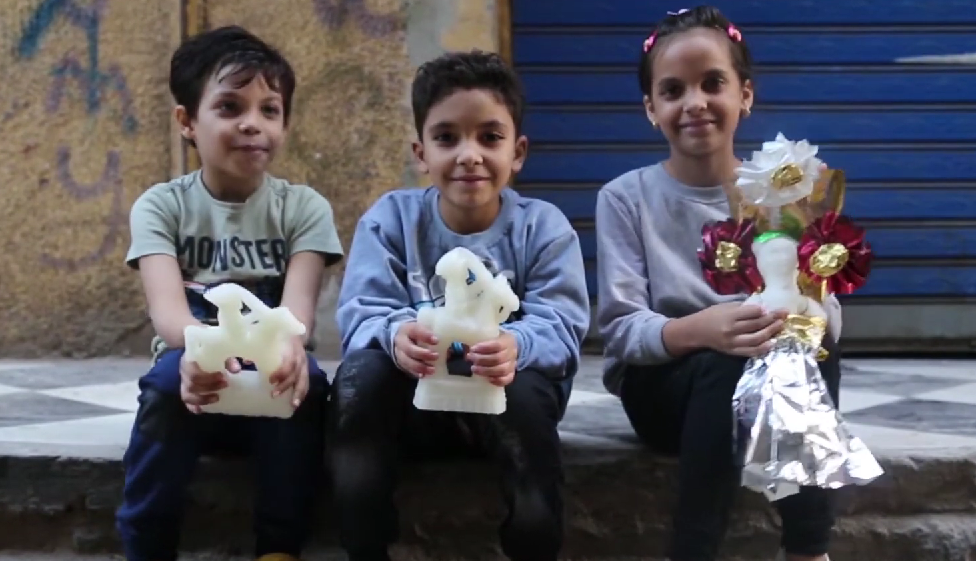
Traditional Egyptian Mawlid dolls, made from sugar and, more recently, plastic
Gifts for the New Year
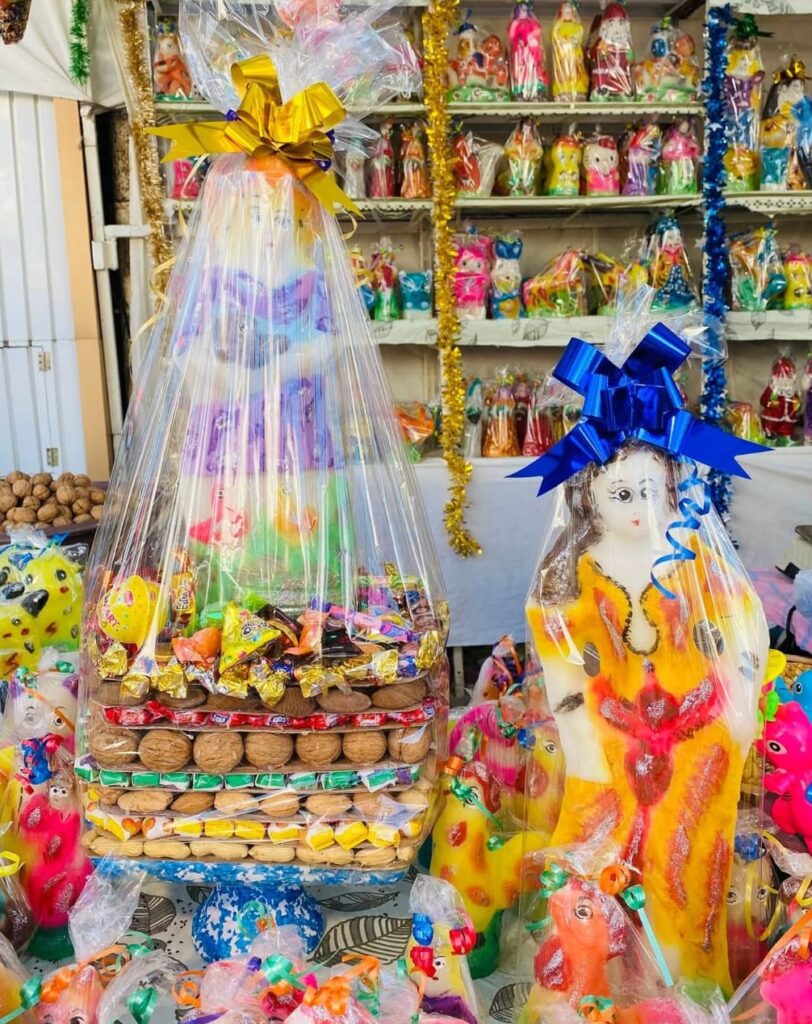
In Nabeul, sugar dolls are traditionally exchanged to celebrate the Hijri New Year. Girls receive elegant female figures, often representing a bride, a gazelle or a fish, while boys are offered horsemen or animals such as roosters, horses and lions.
Another cherished custom sees engaged men presenting their fiancées with a beautifully decorated mithred, a traditional earthenware platter. At its centre stands a sugar bride, surrounded by dried fruits, nuts and sweets arranged with artistic care. In Tunisian Arabic, the word for « doll » (arousa) is also the word for « bride », adding another layer of symbolism to the gift.
Tradition holds that the dolls should be broken and eaten during Achoura, celebrated on the tenth day of the Islamic lunar year. In Tunisia, the occasion is marked by a blend of religious observance and popular traditions, making it the customary time to enjoy the sugar dolls, although many children rarely wait until then.
More Than Sugar Dolls
The Hijri New Year in Nabeul is not limited to sugar figurines. It is also marked by a rich culinary repertoire linked to wishes for prosperity and abundance in the year ahead.
Many families prepare a special couscous made with dried meat (kadid) preserved from Eid al-Adha. Unlike everyday couscous, New Year versions often incorporate sweet ingredients such as raisins, dried fruits or chickpeas and traditionally avoid tomatoes. Another staple is mloukhia, whose deep green colour symbolises fertility, growth and a prosperous year to come.
In Cap Bon, like the bitter orange blossom distillation, the months preceding the Hijri New Year are traditionally marked by seasonal work that mobilizes entire communities preparing the moulds, sugar mixtures and decorations needed for the dolls, often several weeks in advance. These seasonal activities create an economic rhythm that links agriculture, craftsmanship and celebration.
The sugar dolls themselves have evolved over time. Artisans once relied on natural colourings and traditional techniques. Today, ingredients such as cream of tartar—derived from deposits left during the winemaking process—are commonly used to stabilise and shape the sugar. Yet despite these technical changes, the dolls continue to support local workshops, artisans and seasonal economic activity, making them part of a living heritage rather than a museum piece.
Creating the sugar dolls requires skill and patience. Molten sugar is poured into moulds, left to harden and then painted by hand in vibrant colours. Every year, Nabeul celebrates this craftsmanship with a Sugar Doll Festival and competitions rewarding the most beautiful creations.
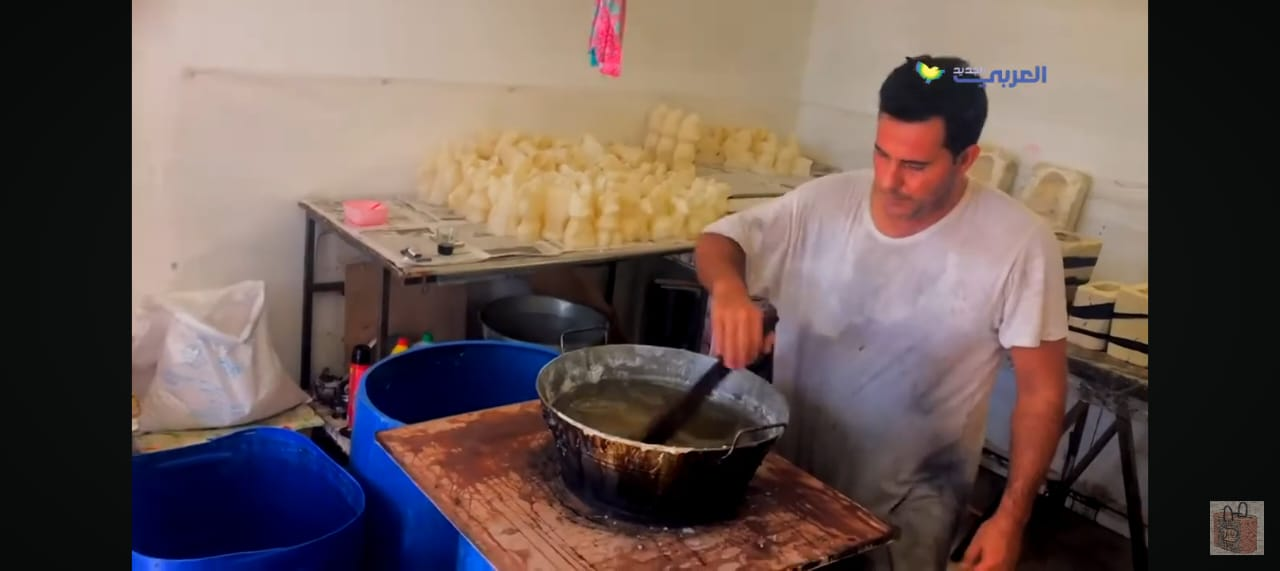
Sugar doll making from a TV interview
An evolving tradition
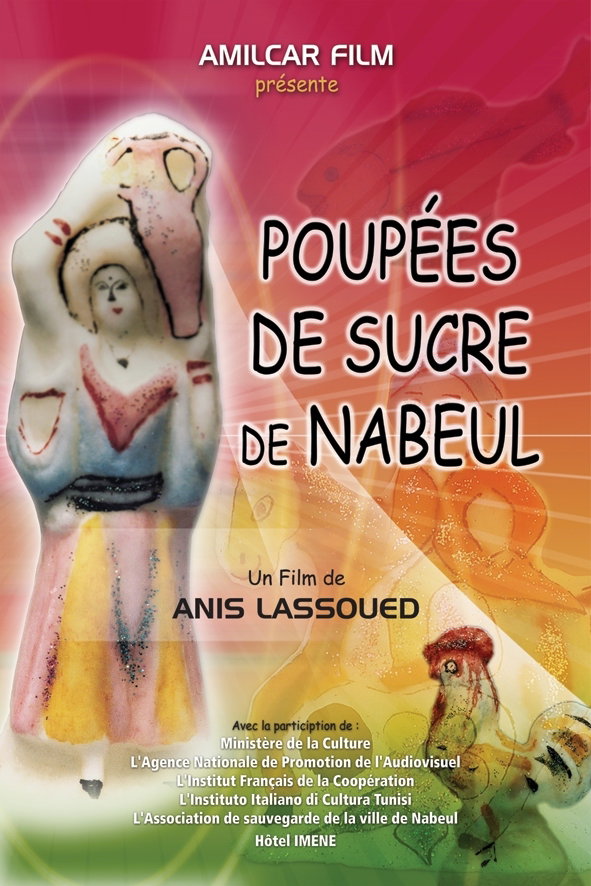
The social meaning of Nabeul’s sugar dolls was memorably explored in the 2006 documentary Sugar Dolls of Nabeul (Poupées de Sucre de Nabeul) by Tunisian filmmaker Anis Lassoued. In one of the film’s most striking scenes, a local resident reflects on his childhood memories of the tradition:
« Ever since I was born, I have known this annual ritual… every little girl would receive a sugar doll on the traditional dish each year until her marriage. As for me, my mother reserved a beautiful sugar rooster for me… The little girls rejoiced at the sight of their doll, which was not really meant to be eaten; the doll would not grow on the dish, but the little girl would grow in life. »
His testimony reveals that these sweets were never simply confectionery. They were symbols carrying social expectations and family aspirations. The female figurine, with its dual meaning of both « doll » and « bride » in Tunisian Arabic, represented a young girl’s future transition into adulthood and marriage. The gifts offered to boys–horses, roosters or horsemen–reflect ideals of masculinity and convey differing gendered roles.
The speaker also recalls that some people referred to the figurines as « the devil’s dolls » because Islam traditionally discourages figurative representations of living creatures, and especially anthropomorphic art. Yet, like other practices that are syncretically absorbed into local religious and cultural life, the sugar dolls have evolved into festive symbols of joy and community identity, integral to the Islamic calendar. In fact, Imed stresses that the sugar dolls are widely understood as part of Tunisia’s cultural heritage rather than as a religious practice.
« People know that this is part of a mythical and cultural heritage. It has nothing to do with religion. »
Far from creating controversy, the tradition has long coexisted with religious life. Families embraced the dolls as symbols of celebration, childhood and community identity rather than objects of worship. As Imed recalls, older generations often found practical uses for them once the festivities were over:
« My mother would eventually break the doll and use it to sweeten tea so that nothing was wasted. »
The longevity of the tradition illustrates how Tunisian society has historically integrated diverse cultural influences while maintaining a clear distinction between heritage, custom and religious practice.
Nabeul’s sugar dolls–perhaps like brightly decorated eggs associated with Easter or the frangipane “Galette des rois” associated with the Epiphany and consumed in France, Quebec and Louisiana 12 days after Christmas–convey craftsmanship, stories of who we are and hope to become, collective memory, and social values in a way that is playful and delicious.
Sugar dolls today include figures of cartoon personalities and Santa Claus
The centrality of children to such traditions is, of course, an indicator of their role in cultural transmission and reproduction, but rather than fixed relics of the past, such living cultural practices continually evolve to reflect contemporary society. The families and artisans that sustain the traditions simultaneously adapt, grow and find new ways to connect past and present.
Making the rhythm of the year
Like many Tunisian traditions, the sugar dolls cannot be understood in isolation. They form part of a wider calendar that combines agricultural cycles, religious celebrations and local economic activities.
Beyond their symbolic value, sugar dolls support local confectioners, artisans and market vendors, demonstrating how cultural traditions can also contribute to local livelihoods and the transmission of skills from one generation to the next.